Why Food Labels Don't Match Macro Math: FDA Rounding Rules Explained
Have you ever multiplied protein by 4, carbs by 4, and fat by 9 on a nutrition facts label and arrived at a completely different calorie total? Here is why.
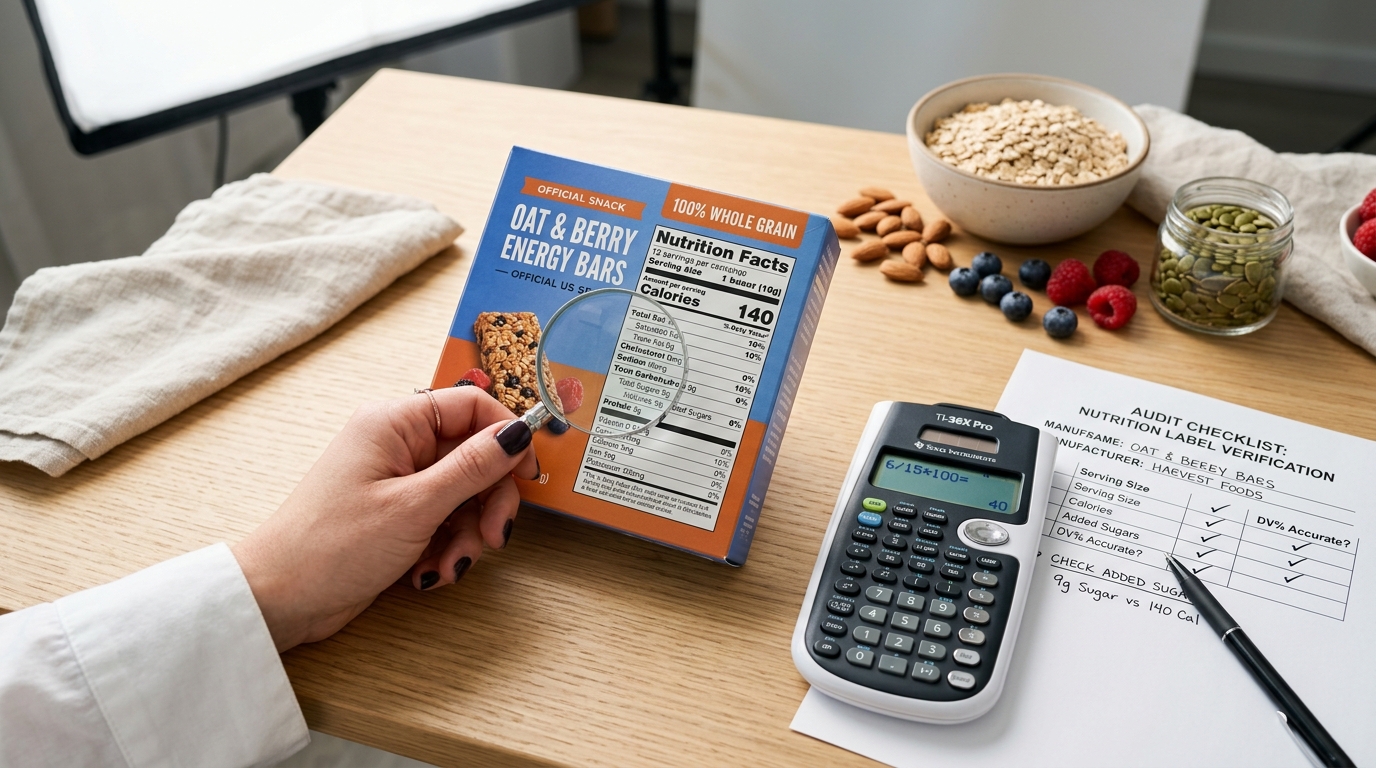
The Discrepancy on Modern Food Labels
If you pick up an energy bar or protein shake and multiply:
- Protein grams × 4
- Carbohydrate grams × 4
- Fat grams × 9
You will frequently find that the stated calories on the label are 5, 10, or even 25 calories higher or lower than your computed mathematical total.
This is not necessarily an error or deception by the manufacturer. Instead, it is the direct outcome of federal statutory rounding rules governed by FDA 21 CFR 101.9.
Federal Rounding Thresholds
Under FDA guidelines, manufacturers do not print raw laboratory precision numbers on consumer packaging. Instead, they apply standardized rounding increments:
- Under 5 Calories: Can be declared as 0 calories.
- 5 to 50 Calories: Expressed to the nearest 5-calorie increment (e.g., 42 kcal becomes 40 kcal).
- Over 50 Calories: Expressed to the nearest 10-calorie increment (e.g., 184 kcal becomes 180 kcal).
Macronutrient Rounding Tolerances
Macronutrients also undergo rounding:
- Less than 0.5g: Declared as 0g.
- 0.5g to 5g: Expressed to the nearest 0.5g.
- Over 5g: Expressed to the nearest whole gram.
For example, a serving containing 4.4g fat, 4.4g carbs, and 4.4g protein contains (4.4 × 9) + (4.4 × 4) + (4.4 × 4) = 74.8 kcal. However, the label may round each macro to 4g or 4.5g, yielding rounded calculations that differ from the stated total.
Fiber and Sugar Alcohol Deductions
Furthermore, manufacturers can choose between multiple FDA-approved methods for calculating declared calories:
- Gross general Atwater factors (4-4-9).
- General Atwater factors minus insoluble dietary fiber.
- Specific chemical combustion factors (Atwater specific food factors).
- Approved biochemical caloric values for polyols (erythritol at 0.2 kcal/g, maltitol at 2.1 kcal/g).
Our built-in Label Checker (Mode 5) in the calculator lets you audit any commercial nutrition panel against the 4-4-9 standard and highlights these variance percentages automatically.